
Franklin County Court Records After Arrest
Franklin County gives stronger public access to court dockets than to jail roster data. After an arrest, a person may be booked at Franklin County Jail, taken before a magistrate, screened by a prosecutor, and placed on a court docket if charges are filed or the case is set. Felony matters commonly move through district court. County-level cases may involve county court or clerk channels, depending on the charge and case type.
The Franklin County District Court dockets are the main official public source for court records after a jail arrest when a criminal case reaches district court. They list 2025 and 2026 docket PDFs, including arraignment, PTR, felony, WHC, bench trial, order of assignment, and court notice items. For current custody and booking status, use Franklin County jail inmate records; for booking photos, use jail roster mugshot request steps instead of assuming a court docket will show an image.
The district docket page is especially useful because it shows the real local field structure for post-arrest court information.
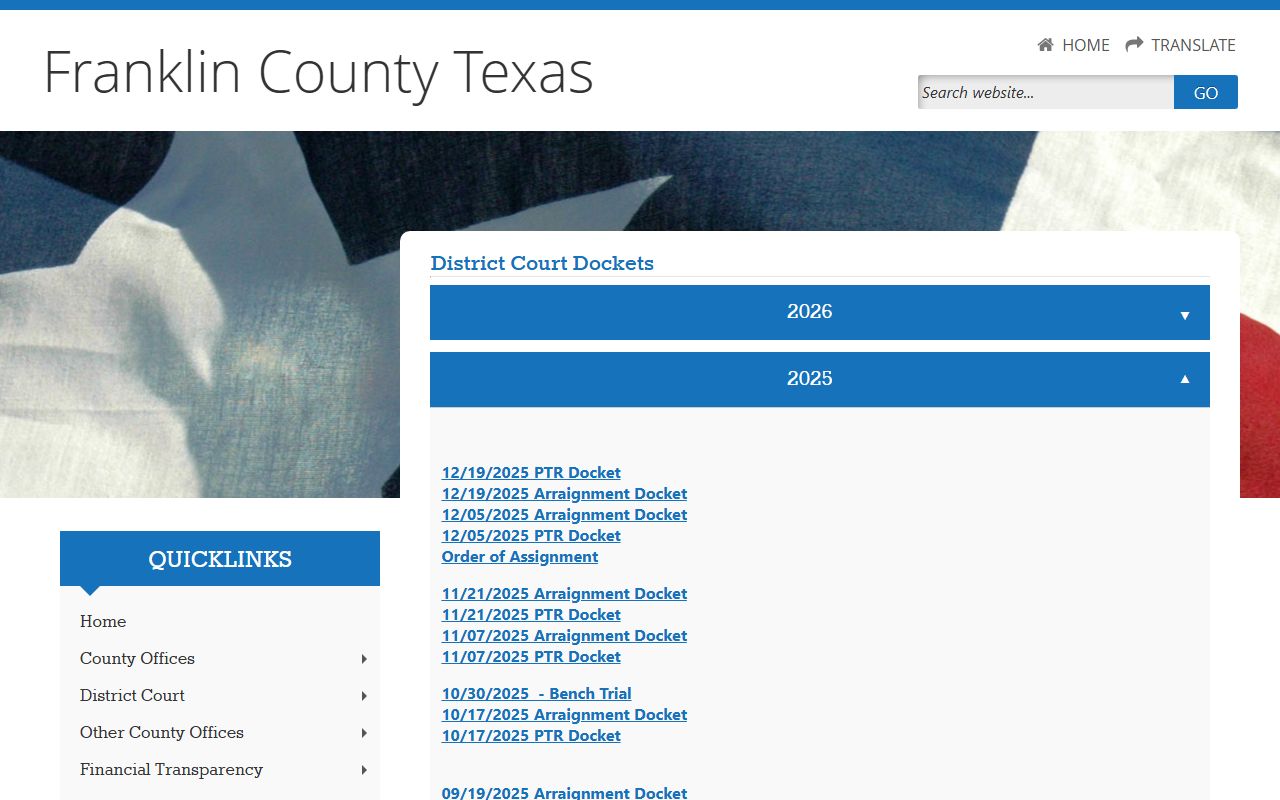
Those docket PDFs are not live custody records, but they are the most concrete official path for charges and settings after a Franklin County arrest.
Arrest to Franklin County Court Records
The post-arrest path starts with jail intake and moves toward court only when the case is screened, filed, indicted, or set. Texas Code of Criminal Procedure Article 15.17 requires a person arrested to be taken before a magistrate without unnecessary delay for warnings, rights, and bail issues. That first appearance can happen before the final charging document is filed.
- Arrest and booking create a custody record at Franklin County Jail or another approved processing point.
- The magistrate process addresses rights, probable cause, bail, and initial release conditions.
- The prosecutor reviews the facts. Felony prosecution is associated with District Attorney Will W. Ramsay, while County Attorney Landon Ramsay is relevant for county-level legal work and likely misdemeanor functions depending on the case.
- A complaint, information, or indictment sets out the formal charge path.
- The case appears on a docket when set for arraignment, PTR, felony docket, sentencing, bench trial, or another court event.
- The final record may show dismissal, plea, trial result, sentence, or another disposition.
That sequence is why a booking charge can differ from a later court charge. The jail record may use the arresting officer's initial label, while the court record reflects what prosecutors filed or what a grand jury returned.
Franklin County Court Docket Fields
Franklin County does not offer a single confirmed criminal case-search portal with live search fields for all post-arrest cases. Instead, the District Court Dockets page uses year sections and dated PDF links. The County Clerk also links a public-access records website where search and viewing are free, but criminal coverage in that portal was not confirmed. Printing through the clerk portal requires registration and payment.
| Field Label | Type | Required | Options / Format Notes |
|---|---|---|---|
| Year accordion or list | Link list | n/a | 2026 and 2025 sections with dated court docket PDFs. |
| Docket type | PDF link | n/a | Arraignment, PTR, felony, WHC, bench trial, order of assignment, or court notice. |
| Defendant | Text in PDF | n/a | Name shown on the docket entry. |
| Charge | Text in PDF | n/a | Plain offense label. |
| Offense date | Date text | n/a | Date tied to the alleged offense. |
| Attorney | Text | n/a | Counsel name if listed. |
| Bond company | Text | n/a | Bail company listed where applicable. |
| Case number | Text | n/a | Sample format observed in research: F-#####. |
| Time and setting | Text | n/a | Example setting types include arraignment and sentencing. |
| Warrant status | Text | n/a | Field appears in docket entries and may be blank. |
The field list is an inventory of what the public docket can show. It is not a promise that every entry has every field filled in.
Franklin County Charging Documents
Court records after a jail arrest usually become clearer when the charging document is known. A complaint is often an early charging instrument or sworn allegation. An information is filed by a prosecutor in certain cases. An indictment is returned by a grand jury and is common in felony prosecution. Franklin County's local rule for newly indicted cases in the 8th Judicial District Court shows that indictment and bond conditions can still matter after a person has left jail.
| Document | Who Uses It | What It Does | Franklin County Note |
|---|---|---|---|
| Complaint | Officer or prosecutor | States an alleged offense and can support early court action. | May appear before the case has a later indictment or disposition. |
| Information | Prosecutor | Formally charges certain offenses without a grand-jury indictment. | Use clerk channels to confirm whether a filed information exists. |
| Indictment | Grand jury | Charges a felony or other qualifying offense after grand-jury action. | Local rules discuss newly indicted cases in Franklin County district court. |
Franklin County Charge Status
A charge status is not static. After a Franklin County arrest, a booking charge can be accepted, rejected, amended, reduced, enhanced, dismissed, or resolved by plea or trial. District docket entries can show where the case sits on a given court date, but they should not be read as the final case history unless the docket or clerk file shows final disposition.
| Status | What It Means | Why It Matters |
|---|---|---|
| Pending | The case or charge has not reached final disposition. | Future settings, bond conditions, or attorney action may still be active. |
| Amended or reduced | The filed charge changed from the original allegation. | The court charge may no longer match the jail booking label. |
| Dismissed | The court ended the charge without a conviction on that count. | Dismissal is not the same as automatic expunction. |
| Plea | The defendant entered a plea and the court accepted or set related terms. | The clerk record is needed for exact disposition terms. |
| Convicted or sentenced | A plea, verdict, or judgment resulted in a conviction and sentence. | State prison sentences later move to TDCJ lookup rather than county jail lookup. |
| Warrant or capias status | A court-issued warrant issue may be noted on a docket. | Contact the issuing court, clerk, counsel, or sheriff before taking action. |
Franklin County Clerk Contacts
Court records after a jail arrest often require the right counter. The District Clerk handles district-court filings and is the better starting point for felony or district criminal case files. The County Clerk handles county records and links to the online public-access records site. The sheriff handles custody, booking, bond, jail status, and records held by the jail. Mixing those roles can lead to incomplete answers.
Franklin County District Clerk
Ellen Jaggers
Franklin County Courthouse Annex West
204 Texas Highway 37
Mount Vernon, TX 75457
903-537-8337
Franklin County Clerk
Brook Bussell
200 North Kaufman Street
Mount Vernon, TX 75457
903-537-8357
The Franklin County Clerk public-access records website is officially linked by the County Clerk. Use it with caution for criminal research because the research confirmed the portal, but not a complete criminal-case search scope.
Bond in Franklin County Court Records
Bond starts as a release issue after arrest, but it can remain visible in court records. Franklin County's District Court sample docket fields include bond company, bond type, and bond amount where populated. The official county site also has a Bail Bond Information page under the sheriff menu, with bail-bond employee applications, individual and corporate surety forms, corporate-agent license applications, assignment forms, property-bondsman assignment forms, and local rules.
| Bond Type | How It Works | Record Caution |
|---|---|---|
| Cash bond | Money is posted directly to secure release and appearance. | Do not assume clerk payment rules are jail bond rules. |
| Surety bond | A licensed bail bond company guarantees appearance for a fee. | Dockets may list the bond company when applicable. |
| Personal or PR bond | Release based on promise to appear and comply with conditions. | Conditions may still apply even after release. |
| Property bond | Real property backs release where accepted. | Local surety assignment rules may apply. |
| No-bond hold or detainer | Release is blocked on that hold until a judge or holding agency resolves it. | One charge with bond does not clear another hold. |
For exact posting rules, contact Franklin County Jail at 903-537-4539. No official local online bond payment method, posting hours, kiosk instruction, or accepted payment list was located for jail bond.
Warrants After Franklin County Arrest
No official Franklin County active-warrant search portal or public warrant list was located. The district criminal docket PDFs include a warrant-status field, but that field is not a live searchable warrant database. A warrant may also come from a lower court, another Texas county, another state, parole, federal court, or immigration authority.
For a Franklin County warrant tied to a jail arrest, call the sheriff or the issuing court before appearing in person. Ask whether a bond is set, whether counsel can file a motion, whether voluntary surrender is required, and whether the warrant is a bench warrant, capias, arrest warrant, fugitive hold, or another agency detainer. For district felony matters, the District Clerk or defense counsel can help identify the court record tied to the warrant.
Franklin County Charges vs Convictions
A court charge after a jail arrest is an accusation or filed allegation. A conviction requires a guilty plea, verdict, judgment, or other final conviction entry. A Franklin County arraignment docket, felony docket, bond listing, or warrant-status note should not be treated as proof of guilt.
| Issue | Charge | Conviction |
|---|---|---|
| Stage | Filed allegation or count in a court case. | Final result based on plea, verdict, or judgment. |
| Proof level | May begin with probable cause or charging review. | Requires the criminal standard or valid plea process. |
| Record meaning | Shows what the State alleged at that stage. | Shows the court's final outcome on that count. |
| Custody link | May relate to jail booking or bond. | May lead to county sentence, probation, fine, or TDCJ transfer. |
Sealed and Expunged Records
Texas public access is broad, but it is not unlimited. Texas Government Code Chapter 552 governs public information, while Texas Code of Criminal Procedure Chapter 55 covers expunction for eligible arrest records. A dismissed charge, acquittal, no-bill, or other favorable result does not always erase a jail or court record automatically. A court order may be needed.
| Issue | Sealed | Expunged |
|---|---|---|
| Public visibility | Hidden from many public searches after a court order. | Removed or treated as not existing for covered agencies after an order. |
| Government access | Some law-enforcement or court access may remain. | Access is much more limited and governed by the order. |
| Eligibility | Depends on Texas law and the case result. | Depends on Chapter 55 and the specific disposition. |
| Franklin County path | Check the clerk file and any order. | Use the court order, clerk, and affected agencies for compliance questions. |
Juvenile records, active investigations, confidential criminal-history information, and records under seal may also be withheld or redacted. Legal advice should come from a licensed Texas attorney.
Franklin County Records After Sentencing
After sentencing, the correct lookup source may change. A person sentenced to state prison from a Franklin County case may wait in county jail until transport and paperwork are complete. Once received by TDCJ, the state locator becomes the better custody source. TDCJ inmate information can include location, offenses, and projected release date, but it is not a county jail roster.
BOP covers federal sentenced inmates from 1982 to present. ICE ODLS covers immigration custody and may require an A-number, country of birth, name, and date of birth. VINELink Texas can provide notifications in some custody situations, but it is not the court clerk and not the jail records custodian.